I put students first in everything I do. I believe each student brings their own background and strengths to the classroom, and they all deserve fair treatment and respect. In my BEd program, I’m learning how to create classrooms where all students feel welcome and can do well. By listening to what students tell me and changing how I teach, I’m finding ways to help different kinds of learners while keeping them interested.
I care about more than just grades – I want to support students’ overall growth. This means building spaces where students can think critically, solve problems, and work together while also developing emotionally. Following the OCT Standard of Practice for Commitment to Students and Student Learning, I try to understand what affects each student’s learning while helping them become responsible members of Canadian society. I believe strongly in equity, making sure every student has what they need to succeed, not just giving everyone the same resources, because fair doesn’t always mean equal.
My time in my BEd program has made me even more dedicated to helping students succeed. Through my classes, teaching practice, and advice from experienced teachers, I’m building skills to create classrooms where mistakes are OK and not giving up is valued. I still have lots to learn, but I’m committed to supporting each student’s curiosity and helping them reach their full potential.
Fall 2025 Practicum Placement
During my Fall 2025 practicum, I kept working on this commitment through a Grade 8 Science unit on Water Systems. The whole point wasn’t just memorizing water properties—it was about getting students to see how water actually affects people’s lives, the environment, and their own communities. I wanted them to realize science isn’t just abstract stuff in a textbook; it’s happening all around them.
To make the tricky concepts easier to grasp, I did this hands-on demo with sand, gravel, clay, and dyed water to show how groundwater and aquifers work. Students could literally watch water moving through different layers, see how pollution spreads, and understand why groundwater gets contaminated so easily. The demo was super helpful for hands-on learners, and it gave everyone a solid understanding before we jumped into the harder research stuff.
For the final project, students got to pick a water issue they actually cared about. Some chose topics like Indigenous communities not having clean drinking water, how much water AI technology uses, or how road salt messes up local ecosystems here in Waterloo Region. Letting them choose their own topic was key—when students care about what they’re researching, they actually want to learn. I gave them lots of support along the way: planning sheets, one-on-one check-ins, peer feedback sessions, and adjusted expectations when students needed it, so everyone could participate no matter their learning style.
For assessment, I used a mix of watching them work, talking with them, and looking at their final products. If a student struggled with writing, they could explain their understanding out loud instead. Students who liked writing got templates and checklists to help them organize everything. The important thing was that every student had a way to show what they learned—how they showed it didn’t really matter.
This unit confirmed what I already believed: when students feel respected and supported, and when they can connect their own interests and backgrounds to what they’re learning, they become curious, stick with challenges, and feel confident. My commitment to students means I’ll keep creating lessons that are relevant, inclusive, and empowering.
Artifacts
The following artifacts demonstrate my commitment to students and learning. Lesson plans are downloadable, videos can be linked via YouTube. A description of each precedes the artifact.
Quick Jump Specific Artifacts
- Bird Beak Battle Comparison
- Social Studies – UDL Aligned Videos
- Biodiversity Slideshow
- Aquifer Demo
- Grade 8 Water Systems Culminating Project
Great Beak Battle Comparison
The Great Beak Battle is an educational activity designed to help students explore biodiversity through the concept of bird beak adaptations. Students compare different bird beak types (represented by human tools) to determine which are best suited for various food sources. Through a hands-on experiment, they analyze how beak shapes influence survival and food acquisition, reinforcing key ecological concepts such as species diversity and ecosystem balance.
This activity aligns with the Ontario College of Teachers (OCT) Commitment to Students and Learning as it:
- Promotes Inquiry-Based Learning – Students engage in hands-on experimentation and critical thinking, fostering curiosity and deeper understanding.
- Encourages Inclusivity and Differentiation – The activity allows students to explore concepts at different levels, making it accessible to various learning styles.
- Develops Environmental Stewardship – By demonstrating the importance of biodiversity, the lesson encourages students to think about conservation and the role of species in ecosystems.
- Supports Student Engagement and Reflection – Follow-up questions require students to reflect on their findings and consider real-world ecological impacts.
Supporting All Learners in Social Studies Through UDL-Aligned Videos
To support my Grade 6 students—many of whom are Multi-Language Learners or on Individual Education Plans (IEPs)—I created custom videos in lieu of having them read dense texts during our Social Studies unit. Using an online platform, I transformed a script (based on curriculum-aligned readings) into short, engaging “breaking news”-style videos. This approach ensured that essential content was accessible to all students, regardless of their reading level. These were customized to the school they attended in order to give them a sense of ‘belonging’ to the information.
This strategy is strongly aligned with Universal Design for Learning (UDL) principles, particularly:
- Provide Multiple Means of Representation
- Offer ways of customizing the display of information
The video format included simplified language, visuals, and narration, allowing students to process content in multimodal ways. - Offer alternatives for auditory information
The combination of visuals and voice-over supported students who struggle with decoding written text, making key ideas more accessible.
- Offer ways of customizing the display of information
- Provide Multiple Means of Engagement
- Optimize relevance, value, and authenticity
The “news report” format made the content more engaging and helped students connect to real-world issues.
- Optimize relevance, value, and authenticity
To reinforce learning, students participated in a reflective activity:
After viewing each video, they wrote down one thing they learned on a sticky note. These notes were added to a classroom mind map—a collaborative visual that helped consolidate ideas and show the connections between different global organizations and Canada’s role on the international stage.
This approach increased engagement and improved comprehension, especially among students who often feel excluded from traditional, text-heavy instruction. The videos were well-received and supported a more inclusive, equitable learning environment.
Links to the videos:
Biodiversity Slide Show


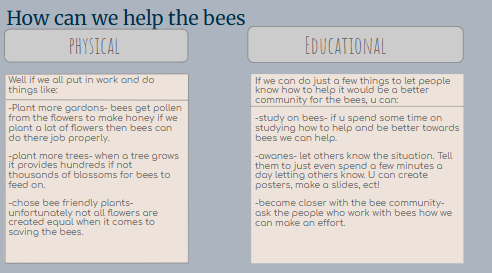
These are examples of completed student slides from a biodiversity assignment.
This assignment aligned with the commitment to student learning by encouraging students to explore local wildlife through their own research. Students chose which species to study and how to present their work (poster, google slide presentation or oral presentation). Clear steps and expectations given in the outline, check-list and rubric helped all students succeed.
The project built both academic and citizenship skills. Students researched their chosen species, created visual presentations, and developed practical conservation plans that could be taken by an 11 or 12 year old student. This helped them understand the impact of human activities on nature, allowed them to picture themselves in a position to improve the world and empowered them to make positive contributions to their community.
By connecting scientific learning with real-world action, the assignment developed informed, engaged students who understood their role in protecting the environment.
During my Grade 8 Science practicum, I started the Water Systems unit with a hands-on groundwater and aquifer demo. I set up layers of sand, gravel, and clay with dyed water so students could actually watch how groundwater moves through different materials and how contamination spreads. It made something that’s normally pretty abstract way more real and concrete, especially for students who learn better by seeing and doing things.
Groundwater & Aquifer Demonstration
This lesson connects to the Commitment to Students and Learning standard because it made the content accessible and engaging for everyone. Students who would’ve struggled to understand this just from reading a textbook could see it happening right in front of them, which meant everyone started the unit with the same solid understanding.
Aquifer demo lesson plan download
Water Systems Culminating Project
For the final project, students got to pick a water issue they actually cared about. Topics ranged from Indigenous communities not having access to clean water, to how road salt affects the environment in Waterloo Region, to how much water AI technology uses globally. Letting them choose their own topic made them way more motivated and helped them connect what we were learning to real issues that matter.
This project shows my commitment to making learning fair and relevant for everyone. I provided clear instructions, offered one-on-one check-ins, and adjusted expectations when needed so every student—including those with absences, IEPs, or anxiety about writing—had a real shot at doing well. I assessed them through conversations, watching them work, and looking at their final products, which let students show their strengths in different ways.
water systems project instructions & rubric download
Success Criteria Checklist
I gave students a checklist with all the success criteria so they could check their own work before turning it in. This helped them take control of their learning and understand exactly what was expected, which is especially important for students who get anxious about being graded.
This artifact supports the OCT standard by encouraging students to take responsibility for their learning and showing them that assessment is there to help, not just to judge. The checklist got them thinking about their work, taking ownership, and making improvements.
success criteria checklist download
Sample Final Student Product (identifying information removed)
I’ve included a sample of a finished project (with all personal info removed) to show student voice and understanding. It demonstrates how students used research, visuals, and critical thinking to communicate what they learned about real water issues.
Showing student work connects to the OCT commitment to student learning because it proves that when expectations are clear and supports are available, all students can create meaningful, high-quality work that shows what they’re capable of.
sample final project slide show
 Shauna McCabe